Housing Instability as a Driver of Infectious Disease in SMI Populations
Unstable housing disrupts TB, hepatitis C, and HIV treatment in people with serious mental illness.
Housing instability helps explain how infectious disease takes hold in people who live with serious mental illness (SMI). It changes exposure, disrupts treatment, and deepens psychiatric distress. Housing belongs within public health infrastructure. Understanding the pathways to TB, hepatitis C, and HIV vulnerability also requires distinguishing what the evidence establishes from what it only suggests.
Why housing instability is an infectious disease problem, not just a social one
Correlation identifies a pattern, but mechanism explains how it develops. Finding more infections among people without stable housing does not, by itself, show how housing loss contributes to infection. The stronger argument follows the changes in a person’s surroundings and access to care. Shared air, overcrowding, and breaks in treatment are pathways through which housing conditions affect the body.
For people with SMI, those pathways also form a feedback loop. Psychiatric symptoms can increase the risk of losing housing, while the stress of homelessness can worsen symptoms and weaken the capacity to regain shelter. The resulting exposure can persist as illness and instability reinforce each other. That makes the conditions that favor infection predictable.
How disproportionate SMI representation in homeless populations sets the scale of the problem
Serious mental illness occurs among people who are homeless at roughly four times its rate in the general adult population. That concentration makes housing-related exposure a population-level concern. Both who loses housing and how long people remain without the support that could interrupt their exposure matter.
For homeless individuals with SMI, the delay between symptom onset and first treatment averages many years and exceeds the already substantial delay among housed people with SMI. Administrative complexity and lack of transportation further obstruct access to mental health and housing services. Exposure can therefore accumulate while psychiatric illness remains untreated. Those barriers help explain the duration of vulnerability. They also challenge explanations centered on an individual’s willingness to seek help.
People with SMI are more likely to live in neighborhoods marked by structural disrepair, greater drug and crime activity, and social isolation. Housing loss may extend an existing period of living in environments that are difficult to remain healthy within.
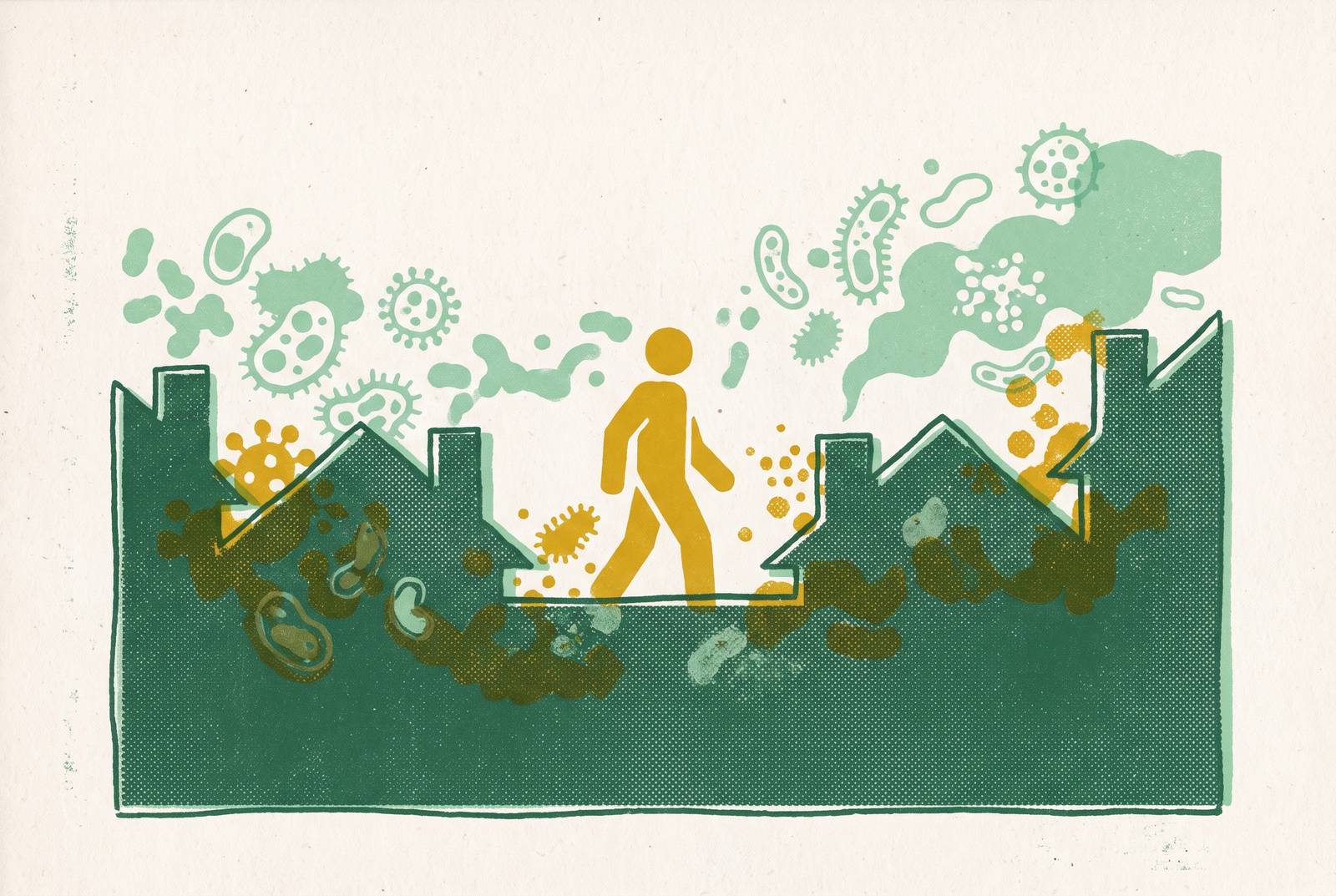
The physical pathways through which shelter, overcrowding, and environmental conditions transmit disease
Tuberculosis provides the clearest connection between a housing environment and a transmission route. CDC says congregate shelters increase the risk of respiratory infection, including TB. Sharing air, being close to others, and the length of exposure help explain how infection can spread in enclosed communal spaces. The higher TB prevalence among people who are homeless fits with that exposure, but prevalence alone cannot show how any one person became infected.
Housing instability also affects what happens after infection. U.S. and Canadian evidence covering two decades found that unstably housed patients had more than twice the odds of dying during TB treatment compared with stably housed patients. This is a different outcome from acquiring TB. It indicates that the housing-to-health pathway extends beyond exposure into the conditions under which treatment takes place. Preventing transmission and supporting survival are connected, but they are not interchangeable endpoints.
Hepatitis C requires a separate explanation. Its reported prevalence among homeless individuals ranges from 4 to 70 times that in the general population, with wide variation across studies. The exposure pathway identified in the evidence includes shared drug use equipment as stable shelter is lost. It is not the shared-air pathway described for TB. Inadequate sanitation is another feature of these environments, but it should not be treated as an interchangeable explanation for every infection. HIV is also identified as a housing-related infectious disease concern, although the evidence supplied here does not establish a distinct HIV transmission mechanism with comparable detail.
Overcrowded housing extends exposure beyond formal shelters. Respiratory, contact, and fecal-oral transmission routes can coexist in crowded environments, while poor ventilation, moisture damage, and mold add further health pressures. Evidence from Indigenous housing conditions in Canada connects disrepair and mold with immune dysfunction that increases vulnerability to bacterial and viral infection. When few homes are affordable, households can end up in these conditions before they become homeless.
How housing cost pressure breaks the medication and care chain before homelessness arrives
The financial pathway begins while a person still has an address. When rent competes with prescriptions, doctor visits, and nutritious food, remaining housed can come at the expense of staying in treatment. A missed prescription may look like an adherence problem in a clinical record. The underlying constraint may be a budget that cannot cover both needs. For infection control, that distinction changes the explanation of where the care chain broke.
Indiana Medicaid’s 2025 IHCP Works Annual Seminar housing presentation links lack of stable housing with poor medication adherence, higher emergency room use, and worsening behavioral health outcomes. Treatment depends on more than a prescription being issued. It also depends on whether daily life permits someone to obtain and take it, and to remain connected with services.
Clinical engagement does not remove these pressures. Food insecurity affected 64 percent of a community mental health clinic sample of people with SMI, showing that substantial deprivation can persist among people already receiving care. That finding, while not measuring infectious disease outcomes, challenges the assumption that reaching a clinic means the conditions needed for treatment are secure.
Why SMI amplifies every step of this vulnerability
SMI intensifies the pathway because the demands imposed by housing instability can collide with the capacities psychiatric illness has already strained. Symptom burden and impaired executive function can make complex service systems harder to navigate. Social isolation can weaken informal safety nets. Trauma and early adversity interact with these pressures. Together, they can make housing harder to retain and harder to regain.
Once housing is lost, worsening symptoms can further disrupt infection management, medication use, and access to services. The same person has more to deal with and fewer resources to draw on. That is the feedback loop’s clinical significance. Each turn can leave someone less able to interrupt the next period of instability, while an infection progresses during the same interval in which psychiatric illness remains untreated.
Stigma-driven discrimination, unemployment, incarceration, and food insecurity further complicate this interaction. These conditions are especially relevant to schizophrenia, major depressive disorder, and bipolar disorder, but they should not be collapsed into the diagnosis itself. SMI’s amplifying role emerges through the interaction between symptoms, material deprivation, and systems that are difficult to enter or remain connected to.
How health equity shapes who bears this burden
The burden is also uneven within the population living with SMI. Racial inequities in housing and mental health access can concentrate exposure among Black, Hispanic or Latino, and other communities of color. NAMI Ohio’s peer workforce report documents that Black, Hispanic or Latino, and Asian American adults were less likely than White or multiracial adults to report receiving mental health services in the past year. That access disparity describes unequal opportunity to receive care that could help stabilize a deteriorating situation.
Neighborhood conditions link this gap in access to the ways housing can expose people to infection. Structural disrepair and social instability are more common in neighborhoods where people with SMI live, and those neighborhoods overlap significantly with communities of color. Demographic categories alone do not explain who is exposed to harmful conditions and who has a realistic route out. Housing access, neighborhood investment, and access to psychiatric care help explain the distribution.
The Indigenous Canadian evidence offers a related structural example without making the populations interchangeable. Housing shortages, overcrowding, and inadequate ventilation caused by colonialism can put a whole community at risk of infection. The comparison concerns how disinvestment produces exposure.
What the evidence says about housing stability as a direct health intervention
Enterprise Community Partners and the Center for Outcomes Research and Education analyzed a study finding that emergency department use fell, outpatient primary care use increased, and Medicaid expenditures declined after people moved into affordable housing. The direction of change is consistent with greater continuity of care. It is not, by itself, proof of fewer infectious disease cases. Emergency department use and spending cover many health needs, so more evidence is needed to show an effect on a specific disease.
Stable housing makes it practical to store and take medications, keep appointments, and address health problems before they escalate. These are concrete changes in treatment conditions. They help explain why housing can function as a health intervention without being a substitute for medical care.
Provision alone is not the entire intervention, however. Placement speed, service intensity, program fidelity, and neighborhood conditions influence whether housing stability is sustained. A placement’s health value therefore depends partly on its setting and the support around it. The evidence supports a qualified conclusion. Stabilization changes conditions that produce exposure and disrupt treatment, while the extent of its effect on particular infections requires careful evaluation.
Why peer support is positioned to interrupt this cycle where clinical models cannot
Housing and clinical services can help people only if they keep them in care. For people who are homeless, distrust institutions, or have gone years without treatment contact, the missing connection may be relational. Peer support draws on lived experience to help make that connection. Meeting people in the community can create a route back to housing, food, medication, and behavioral health resources when conventional clinical contact has broken down.
Evidence supports parts of that role, but not every possible claim. Studies cited in the UPSIDES international research program found that peer support workers did better than professionals at reducing the use of inpatient services and improving care engagement and recovery-related outcomes. These outcomes fit the problem of repeated disconnection. They do not establish that peer support itself provides housing or prevents a particular infection.
The PeerTECH randomized controlled trial offers a more specific medical connection. Its 12-week mobile health intervention, delivered by Certified Peer Support Specialists to adults with SMI and at least one medical comorbidity, demonstrated feasibility and effectiveness in enhancing self-management, with physical health improvements. That supports a role beyond psychiatric engagement alone. It does not make peers interchangeable with clinicians.
The limits deserve equal attention. Meta-analytic evidence on patient activation in schizophrenia was mostly rated low quality, and one high-quality synthesis found no effect between one and six months of follow-up. Peer support is therefore best understood here as connective tissue. Its role is to help people re-engage with services that must supply housing and medical resources.
What treating housing as public health infrastructure would actually require
The practical implication is that housing support must be designed, funded, and evaluated as part of preventing illness, with relational support built into access. That frame includes the time it takes to secure housing, the intensity of services, and the barriers that interrupt continued engagement. Buildings alone are not the whole infrastructure. The people who connect residents to care are part of it too.
The 2023 Consolidated Appropriations Act provided limited clarification that peer support specialists can participate as auxiliary personnel in delivering certain Medicare behavioral health and crisis services. Senator Kaine’s 2025 PEER Support Act would direct the Office of Management and Budget to revise the Standard Occupational Classification system to recognize peer support specialists as a profession. Recognition and payment are distinct parts of integration. Neither makes an adequate workforce available by itself.
Rhode Island’s formal incorporation of peer roles into its 988-crisis response system and Certified Community Behavioral Health Clinics illustrates system-level integration. Yet even with many more peer specialists than a decade ago, there are still far too few to meet the need. That gap constrains what service models can deliver. Getting housing without staying connected to care can leave people at risk of breaks in treatment.
For health plans and provider systems, this reframes the purpose of housing support and peer navigation. They address environmental exposure and treatment disruption that can culminate in preventable, expensive infectious disease hospitalizations. The financial logic converges with the public health logic at those mechanisms. Costs borne by the health system can begin in housing conditions that no individual patient can resolve through adherence or effort alone.