Barriers to Preventive Care Among Uninsured Adults
Cost barriers and lost care relationships explain why uninsured adults skip preventive screenings.
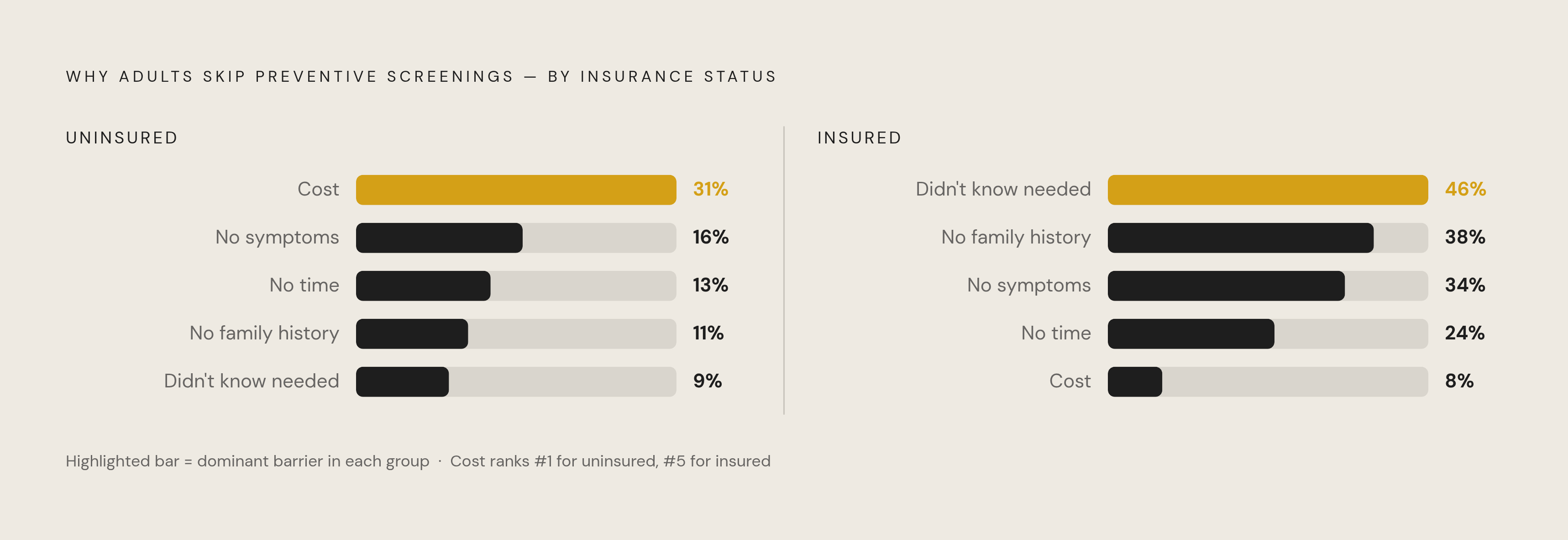
The numbers are unambiguous on their face. Thirty-one percent of uninsured adults delayed or skipped care due to cost in 2024, according to KFF and Health System Tracker data; only 8% of insured adults said the same. For cancer screening specifically, 35% of adults who missed a routine screening named cost as a factor, and among those who cited cost as their primary concern, roughly half pointed specifically to out-of-pocket expenses for the screening or appointment itself. By 2026, the share of adults listing cost as their primary concern around screenings had risen to 34%, up sharply from 25% the year prior, now matching the share who say they fear a cancer diagnosis itself. Two very different anxieties arriving at the same number is the kind of coincidence that stops you mid-sentence.
The structural underpinnings are worth stating plainly. Roughly 70% of uninsured working adults in 2024 lacked employer-based coverage. Of those, 60.5% worked for employers that simply didn't offer it; another 9.9% were ineligible due to part-time or contract status. Family coverage premiums rose 53% from 2015 to 2025, while the worker's share of that premium rose 37%. Coverage has become structurally unaffordable even for people for whom it is technically available.
Then look at what insured adults say when they skip the same screenings. Forty-six percent say they didn't know they needed to be screened. Thirty-eight percent cite no family history. Thirty-four percent cite no symptoms. Cost ranks fifth. The same behavior, skipping a preventive screening, has categorically different root causes depending on insurance status. That asymmetry is what cost-centered explanations cannot account for, and it is the thing I keep returning to after years of watching coverage-expansion arguments collapse at the point of implementation. Cost is the floor of the barrier problem, not the ceiling.
What losing a primary care relationship does to preventive care
Uninsured adults rarely maintain a consistent primary care provider. This sounds like a consequence of being uninsured, and it is. It is also independently predictive of worse preventive outcomes in ways that compound the cost problem rather than simply restate it.
The 2021 National Health Interview Survey makes the relational dimension concrete: both breast and colorectal cancer screening rates fell well below a majority among people who were either uninsured or had no usual source of care. The coverage card matters, but so does the care relationship that the coverage card is supposed to sustain. Those are not the same thing, and policy often treats them as if they are.
The emergency department data reinforces this. Among uninsured adults without a usual source of care, 24.1% used the ED for half or more of their ambulatory visits. Among uninsured adults who did have a usual care relationship, that figure dropped to 8.8%. A 16-percentage-point gap is a measurement of what a longitudinal care relationship is structurally worth. The ED is built for acute problems. It is not the setting where a clinician asks a 48-year-old when they last had a colonoscopy.
What emerges is a self-reinforcing cycle: no insurance forecloses a primary care relationship, which removes the person who would recommend and order screenings, which raises the probability of advanced-stage disease presentation, which drives ED utilization, which deepens financial strain. The barrier here is relational. Even when cost is temporarily removed, as it is at a free screening event, adults without ongoing care relationships often don't know what they need or who to follow up with afterward. Covering the test does not replace the relationship that would have prompted it.
How large the screening gap actually is when you look at the numbers
The aggregate statistics obscure how dramatic the screening disparity becomes at the level of specific tests and age groups. Among adults 45 to 64 in 2023, the colorectal cancer screening rate among uninsured adults was 23.0%; among adults with private insurance in the same cohort, it was 61.7%. The insured group was screened at more than two and a half times the rate of the uninsured group. That is not a marginal difference in access. It is a different universe of health behavior.
Survey data reinforces this from a different angle. Adults 45 and older without insurance reported being behind on colorectal cancer screening 71% of the time, versus 33% for insured adults of the same age. For cervical cancer, uninsured women reported being behind 67% of the time, compared to 41% for insured women. Adults with continuous private coverage, not just any insurance but continuous coverage, had an 80.5% breast screening rate and a 65.4% colorectal screening rate. Continuity matters here in ways that complicate simple coverage-expansion arguments: gaps in coverage, even temporary ones, erode screening behavior in ways that extend beyond the uninsured period itself. That finding tends to get buried in the policy conversation, and it probably shouldn't be.
The AACR Cancer Disparities Report 2024 found that insurance status is the single strongest driver of screening disparities across cancer types, more pronounced than race, income, or geography when examined in isolation. That finding does not diminish those other variables; it reframes them. Many are, in part, proxies for insurance status. The screening gap is not a separate phenomenon from the barriers described above. It is their measurable downstream expression.
The policy gap that traps people below the reach of both Medicaid and marketplace coverage
More than 1.5 million uninsured adults currently sit in what policy researchers call the Medicaid coverage gap: incomes below the federal poverty level, disqualifying them from ACA marketplace subsidies, yet living in one of the ten states that have not adopted Medicaid expansion. In 2024, working-age adults in non-expansion states were uninsured at a rate of 17.4%, versus 9.3% in expansion states. Geography is doing the work that individual circumstance should not determine.
The safety net that does exist for these adults is Emergency Medicaid, which covers unpredictable acute emergencies and explicitly excludes preventive care. The policy apparatus has engineered a hole precisely where prevention would happen. That is not hyperbole; it is the logical structure of the benefit.
The coverage gap is not racially neutral. Sixty-five percent of people in the gap are people of color. Black adults make up a disproportionately large share of the gap population while representing roughly a tenth of the overall U.S. population; Latino adults make up 35% of the gap population while representing 19% of the overall population. The financial and structural barriers already documented here fall disproportionately on communities for whom the most obvious policy remedy, Medicaid expansion, has been withheld at the state level. That is a policy choice, not an inevitability.
KFF projects that current federal legislative proposals could add roughly 17 million more uninsured people. The trajectory is not toward resolution.
The non-financial barriers that persist even when cost is addressed
Nearly one in five adults who are behind on cancer screening, a significant minority according to the Prevent Cancer Foundation's 2026 Early Detection Survey, cited skepticism toward the health care system as their reason. Insurance cannot erase that. The Aflac Wellness Matters Survey of 2,000 employed U.S. adults in 2025 found that a large majority of Americans delay preventive care, with barriers including fear, embarrassment, and logistical friction. That finding matters because it comes from the insured population. Non-financial barriers exist broadly; they compound specifically for the uninsured.
Health literacy is one layer. Uninsured adults often lack the ongoing provider relationship that would surface screening recommendations organically. They don't always know what they need, at what age, or how often. The insured adult who skips a screening because they "didn't know they needed it" has a primary care provider who could have told them. The uninsured adult has no such corrective, and nobody is closing that loop.
Language access is another. Communities with limited English proficiency face compounded difficulty navigating systems that are already difficult for native speakers. Translation services are inconsistent, culturally competent care is unevenly distributed, and the logistical overhead of finding a provider is higher when you cannot easily read or make a phone call in the dominant language.
Transportation and time carry real costs that don't appear in coverage statistics. Missing work for an appointment carries genuine income risk for hourly or gig workers, who make up a disproportionate share of the uninsured. A free screening is not free if it costs a day's wages.
Distrust may be the least tractable of these. For communities with histories of medical mistreatment, provider trust is not a starting assumption. The episodic, transactional care that uninsured adults typically receive, an ED visit here, an urgent care visit there, does little to build the kind of relationship in which distrust begins to erode. Research further shows that people with lower socioeconomic status, limited educational attainment, and language barriers face greater difficulty understanding even the coverage options theoretically available to them, compounding the problem at the point of entry itself.
Expand coverage, and you move the needle. You do not close the gap.
How the layers interact and what that means for anyone trying to close the gap
These barriers do not operate sequentially or independently. Cost prevents coverage. Lost coverage eliminates the primary care relationship. The absence of that relationship removes the informational trigger for screening. Policy gaps exclude the lowest-income adults from any coverage pathway. Distrust, logistical friction, and health literacy deficits persist even when coverage theoretically exists.
Consider a part-time worker in a non-expansion state, uninsured, with limited English proficiency and no regular provider. They are not facing a problem that yields to any single intervention. They face cost, structural exclusion, informational absence, and earned distrust simultaneously. That is a qualitatively different situation than someone who simply can't afford a copay, and conflating the two has led to a lot of well-funded programs that work for some people and miss others entirely.
The racial and geographic concentration of these layered barriers means their compounding effect is not randomly distributed across the population. It tracks closely with communities that already carry higher chronic disease burden, a point the coverage gap demographics make quantitatively clear. The burden is not equal, and neither is the gap between what prevention costs early and what late-stage disease costs in the ED.
Interventions that address only one layer will reach some people and miss others. Free screenings without transportation support or navigation assistance reach the person who already knows what they need and can get there. Coverage expansion without investment in health literacy reaches the person who can navigate an enrollment form. Each partial solution has real value; none is sufficient on its own, and the evidence makes it difficult to keep pretending otherwise.
Whether cost is the whole story for the whole population is, at this point, a question the data has largely answered. It isn't. The policy implications of that distinction are substantial, and the place to start is wherever the layers pile highest.